what is the ancestry dna kit compared to the u.s. discovery kit
Commercials abound for Dna testing services that will assistance you learn where your ancestors came from or connect you with relatives. I've been interested in my family history for a long fourth dimension. I knew basically where our roots were: the British Isles, Federal republic of germany and Hungary. Simply the ads tempted me to swoop deeper.
Previous experience taught me that different genetic testing companies can yield different results (SN: 5/26/18, p. 28). And I knew that a company tin can match people just to relatives in its customer base of operations, so if I wanted to find as many relatives as possible, I would need to use multiple companies. I sent my DNA to Living Deoxyribonucleic acid, Family Tree DNA, 23andMe and AncestryDNA. I as well bought the National Geographic Geno 2.0 app through the visitor Helix. Helix read, or sequenced, my Deoxyribonucleic acid, then sent the information to National Geographic to clarify.
These companies clarify hundreds of thousands of natural DNA spelling variations chosen single nucleotide polymorphisms, or SNPs. To estimate ethnic makeup, a company compares your overall SNP blueprint with those of people from around the world. SNP matches also help companies run across who in their database yous're related to.
Some of the companies besides clarify a person's Y chromosome or mitochondrial Deoxyribonucleic acid. Y chromosome DNA traces a man'south paternal line. In contrast, mitochondrial DNA traces maternal heritage, since people inherit mitochondria, which generate energy for cells, only from their mothers. Neither blazon of Deoxyribonucleic acid changes that much over time, and then those tests usually tin can't tell you much well-nigh recent ancestors.
Once I sent in Dna samples, my Web-based results arrived in simply a few weeks. Merely my user experience, and results, were quite different for each company.
National Geographic Geno 2.0
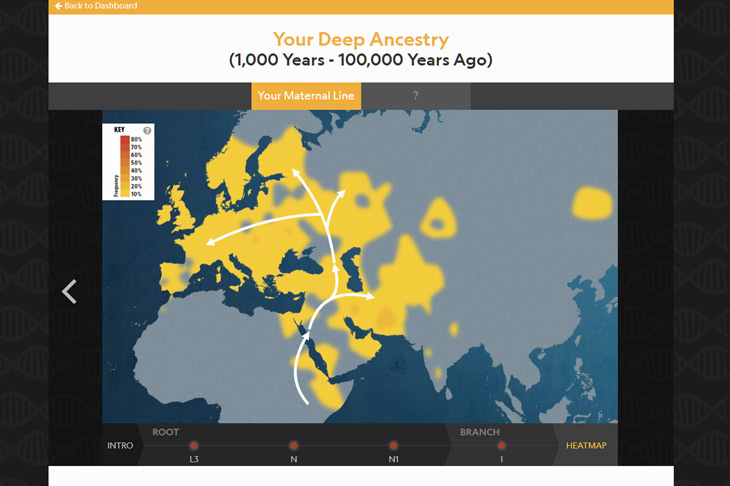
At $199.95, National Geographic's examination is the most expensive, nevertheless the least useful. The results are generic, and the ethnicity categories are overly broad. My results say that 45 per centum of my heritage came from people living in southwestern Europe 500 to x,000 years ago. That doesn't tell me much and doesn't reflect what I know of my family history.
There'southward no relative matching, though Geno 2.0 shows which historical "geniuses" may take shared your mitochondrial or Y chromosome DNA. I don't know how National Geographic knows about the mitochondria of Petrarch, Copernicus or Abraham Lincoln. And so I'grand skeptical that I am really related to those famous figures, fifty-fifty from the distance of 65,000 years, the concluding time nosotros supposedly had an ancestor in mutual. The service also calculated the percentage of Neandertal ancestry that I deport. I take geeky pride that 1.5 percent of my DNA comes from Neandertals, topping the ane.iii percent average for Geno 2.0 customers.
Overall, Geno 2.0 has a squeamish presentation, only I learned more about my family history elsewhere. Since I bought the Geno ii.0 kit as an app through Helix, I don't know if the kit purchased directly from National Geographic, which is processed by Family unit Tree Dna, would yield different results.
Living Deoxyribonucleic acid
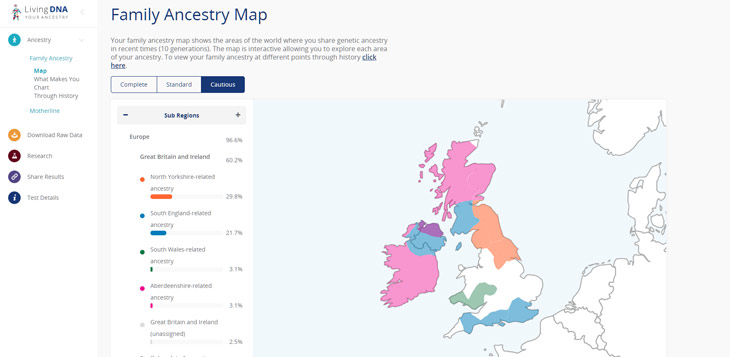
Some other expensive test ($159) came from Living DNA. When I saw the company'southward ad claiming to pinpoint exactly where in the British Isles a person'due south genetic roots stalk from, I decided to give it a go. The visitor highlights ethnicity on a globe map, then lets y'all zoom in from the continent level. I found that 22.5 percent of my heritage came from Lincolnshire in east-key England. I haven't yet traced any ancestors to Lincolnshire, but I did notice through much genealogical sleuthing that one of my sixth-not bad-grandfathers came from Aberdeen, Scotland. Living Dna says that 3.1 percentage of my Dna is from Aberdeenshire. Written narratives on the website provide a history of each reported region.
Using mitochondrial DNA and, if applicable, Y chromosome DNA, the company can trace your maternal and paternal lines back to human origins in Africa and testify where and when your item line probably branched off the original. My "motherline" probably arose in the Near East nineteen,000 to 26,000 years agone, Living Dna claims, and my ancestors were some of the offset people to enter Europe. In February, the company appear that it would soon launch a relative-matching service for its customers.
I'm not sure the service would be worth the price tag for people whose ancestry doesn't contain a strong British or Irish tilt, though Living Deoxyribonucleic acid says it is working to improve ethnicity estimates in Frg and elsewhere.
Family Tree Deoxyribonucleic acid
The virtually no-frills of the bunch is Family Tree Deoxyribonucleic acid. For $79, "autosomal" testing looks for genetic variants on all of the chromosomes except the X and Y sexual activity chromosomes. Y chromosome and mitochondrial DNA analysis costs extra.
Family Tree DNA allows a user to build a family tree, incorporating personal DNA tests and matches from the site'due south relative-matching section. I found more than 2,400 potential relatives. A chromosome viewer lets me see exactly which bit of DNA I have in mutual with whatever particular relative, or with upwards to five relatives at a time. That feature also allows users to trace how they inherited DNA from a shared ancestor. Only I found this tool difficult to apply.
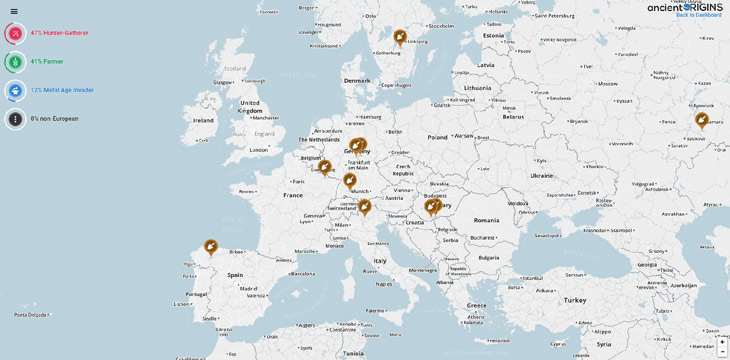
The website offers little explanation of results. For case, I was excited to run across that my DNA was compared with that of aboriginal Europeans, including Ötzi the Iceman, who lived 5,300 years ago (SN: nine/17/16, p. 9). Family Tree Dna is the only company I tried that incorporates aboriginal DNA into its results and that characteristic was what convinced me try this company. I did get a breakdown of how dissimilar groups — Stone Age hunter-gatherers, early on farmers and "Metallic Age Invaders" from the Eurasian steppes — contributed to my DNA. But when I saw Ötzi's dot on my beginnings map, it wasn't clear if that meant we share Deoxyribonucleic acid or if the map was merely showing where he lived.
23andMe
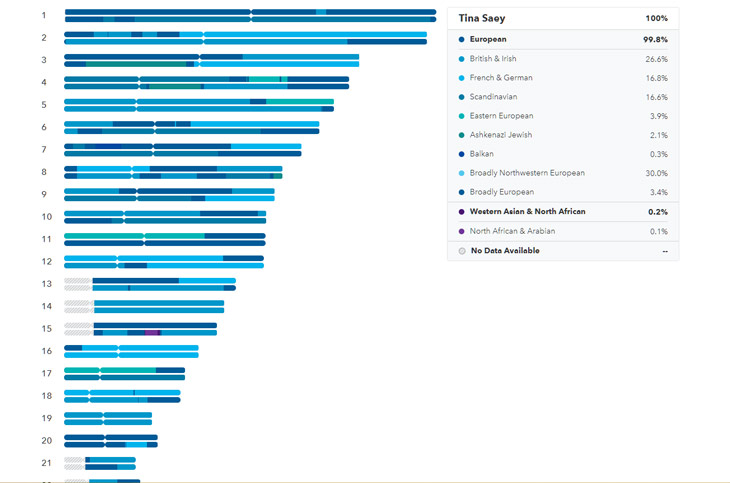
23andMe ($99) offers ane of the more complete packages of information. Almost companies bear witness a map of indigenous heritage. 23andMe does, too, simply also presents an interactive diagram of all of a person's chromosomes, indicating which portions carry a item indigenous ancestry. Because my parents besides did 23andMe, I learned that my dad handed me a tiny bit of chromosome xv that carries western Asian and northern African heritage. My mom gave me the 0.3 percent of my Deoxyribonucleic acid that comes from the Balkans, in a single chunk on chromosome 7, which makes sense since her grandparents came from Hungary. Playing with the chromosomes is fun. Simply I question the accuracy of these results (encounter my related article for more on why ancestry tests may miss the mark).
23andMe presents Neandertal heritage in terms of the number of genetic variants yous carry. A family-and-friends scoreboard shows where y'all stack up. (I top my leaderboard with 296 Neandertal variants, more than than what 80 percentage of 23andMe customers have.) The report likewise explains what some of those Neandertal variants practise, including ones linked to back pilus, straight hair, summit and whether you're likely to sneeze after eating dark chocolate. The company doesn't test for all possible Neandertal variants, including ones that have been linked to health (SN Online: 10/10/17; SN: 3/5/16, p. xviii).
Similar Geno ii.0, 23andMe uses mitochondrial and Y chromosome DNA to trace the migration patterns of a person's ancestors, from Africa to the nowadays mean solar day.
Relative matching is both interesting and frustrating. I could see the people I friction match, how nosotros might be related and compare our chromosomes. But 23andMe doesn't provide a way to build family trees to further explore these relationships.
AncestryDNA
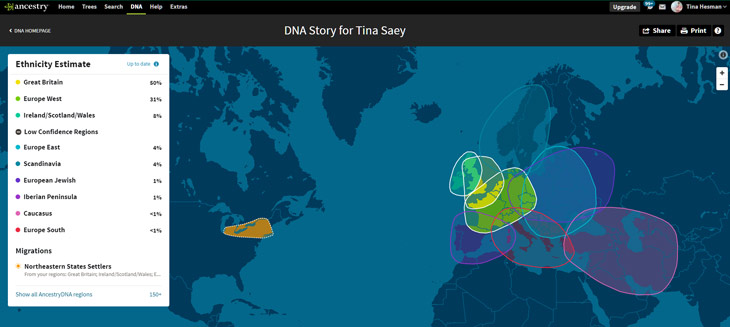
AncestryDNA ($99) doesn't requite the diverseness of information other companies practise. Simply it has useful genealogical tools, provided you link your results to a family tree that y'all can build with help from historical records via a paid subscription to Ancestry.com.
Ane interesting feature of my heritage study was that it went across spots on the map in Europe to besides testify a region of the Us chosen "Northeastern States Settlers." A match to that category tells me that my ancestors who came from Europe probably initially settled in New England or around the Great Lakes. They did. 1 branch of my family tree gear up roots in Massachusetts in the 1640s. Using birth, expiry and immigrant records from Ancestry.com, I could build a timeline to bear witness when and from where individual ancestors immigrated to the The states.
AncestryDNA also matches y'all with relatives, only you tin can only see how you're related to those people if they have also called to brand family trees.
A feature unique to AncestryDNA is called Dna circles. It shows connections between individuals and family groups who share Deoxyribonucleic acid with you. These circles besides contain descendants of your ancestors who you don't straight share Deoxyribonucleic acid with. Therefore, this feature allows yous to extend relative matches across what traditional DNA matching tin practice.
For instance, I am in a family group with my uncle and a cousin. We all share Dna with 24 other descendants of Samuel Pickerill, a drummer during the Revolutionary War. Pickerill has 42 other descendants with whom my family grouping doesn't share DNA. Those 42 Pickerill descendants happened to inherit different $.25 of DNA from Pickerill than my uncle, his cousin and I did. That sometimes happens because of the random nature of the rules of biology and genetics (for more on those rules, check out this video).
Genealogy junkie
Although I've always been interested in family unit history, DNA testing has gotten me hooked on genealogy research.
23andMe and AncestryDNA were the well-nigh fun to use. 23andMe can tell me whether a relative is on my mother'south or begetter'due south side of the family. Merely then I accept to go dorsum to AncestryDNA and comb through my family tree to learn how nosotros're actually connected. DNA can kick-outset a genealogy chase, only combing through marriage certificates, military rolls, census records, immigration documents, old photographs and other records — which Ancestry.com can provide — is what really tells me who my ancestors were.
gibsontiorstionat.blogspot.com
Source: https://www.sciencenews.org/article/family-dna-ancestry-tests-review-comparison
0 Response to "what is the ancestry dna kit compared to the u.s. discovery kit"
Post a Comment