How Did Thr Designer of This German Folk Dress Use the Principles of Art

Woman wearing modern dirndl with mid-length skirt.


Traditional long-skirted dirndls from Lienz in Tyrol, Austria, 2015
A dirndl (German: [ˈdɪʁndl̩] (  listen )) is a feminine wearing apparel which originated in German-speaking areas of the Alps. It is traditionally worn past women and girls in Bavaria (south-eastern Germany), Austria, Liechtenstein, Switzerland and Alpine regions of Italy. A dirndl consists of a close-fitting bodice featuring a depression neckline, a blouse worn under the bodice, a wide high-waisted skirt and an apron.[ane] [2] [3]
The dirndl is regarded equally a folk costume (in High german Tracht). Information technology developed as the clothing of Tall peasants between the 16th and 18th centuries.[1] [four] [5] Today it is generally considered the traditional apparel for women and girls in High german-speaking parts of the Alps, with detail designs associated with dissimilar regions. The usual masculine tracht counterpart of the dirndl is lederhosen.
In the late 19th century the dirndl was adapted by the upper and middle classes as a fashion mode, and later on spread equally a way outside its area of origin. There are many varieties of adaptations from the original folk designs.[1] The dirndl is besides worn equally an ethnic costume by German diaspora populations in other countries.
Name [edit]
Dirndl is a atomic of Dirn(eastward). Although in current German usage, Dirne now generally signifies 'prostitute', the word originally meant merely 'young woman'.[6] In Bavaria and Austria, Dirndl tin can hateful a young woman, a girlfriend or the clothes. The dress tin can for clarity be called Dirndlkleid (literally 'immature woman'southward dress') or Dirndlgewand ('young woman's clothing').[seven] [8] [4]
Dirndl is the class of the word in Standard German. In the Bavarian and Austrian dialects of German (Bairisch), the word is interchangeably Dirndl or Diandl.[8]

Women wearing the traditional blue dirndl from the Wachau region of Austria.
Speakers of High german take conflicting opinions as to whether the proper noun "dirndl" tin can be used for traditional also as modern designs. Some speakers make a sharp break between traditional folk costume (tracht) and the "dirndl", a word which they use but for modern designs. For instance, tracht scholar Thekla Weissengruber distinguishes between renewed tracht (based closely upon historical designs) and Trachtenbekleidung (tracht habiliment), including dirndls and lederhosen. She says: "In this category the designs in full general go along to patterns which become back to the historical costume models; only the materials, skirt lengths and color compositions change from season to flavor and represent to the trends coming from centres of fashion."[ix] [10] This distinction assumes that the term "dirndl" describes only clothing of more than modernistic design.
Notwithstanding, many other German-speakers apply the terms "dirndl" and "tracht" interchangeably for a woman´s wearing apparel of the general dirndl way, regardless of whether the design is traditional or mod. For example, tracht scholar Gexi Tostmann, who sees the modern dirndl every bit having evolved from traditional tracht designs, also uses the term "dirndl" for historical designs.[1] [eleven] [12] A developing consensus is that a dirndl tin be described every bit "tracht" when information technology has been traditionally worn by a distinct people group over a long period.[thirteen] This implies that a dress based on the design principles of Tall tracht can besides be called a "dirndl", fifty-fifty if it has a documented history of centuries equally a folk costume. For example, the traditional bluish polka-dotted dress of the Wachau region of Austria can exist referred to either as "Wachauer Tracht"[14] [15] or as the "Wachauer (everyday) dirndl"[xi] [15] [16] In English, the proper name "dirndl" is used interchangeably for traditional and mod designs.[2] [17]
Clarification [edit]
Basic design [edit]
The dirndl consists of a bodice, skirt, blouse, and apron.[1] [4] [18] [19] [20]
The bodice (in German Mieder or Leiberl) is tight to the body, with a deep neckline (décolletage). Information technology is typically fabricated in a single piece, with the join in the forepart centre, secured past lacing, buttons, a hook-and-centre closure or a zip. A nil can too be on the back or the side. Traditionally, the bodice was made from dark heavy cotton, so that it would be hard-wearing. In more than modern designs, it may exist made from cotton, linen, velvet or silk. The cloth is coloured or printed. The neckline (Ausschnitt) of the bodice is traditionally round or rectangular (called "balconette"). In more modern designs, it may alternatively exist high, V-shaped, heart-shaped or extra deep. The bodice often has embroidered decoration, especially when worn for public events.[1] [4] [11] [21]
The skirt (Stone) is total, with folds gathered in at the waist. Before the 1930s, it was separate from the bodice, but since so the two take been sewn to i another. Originally the skirt was long, just in more modern designs it is typically mid-length. Miniskirt versions as well exist. Traditionally, the brim has a pocket on the side or in front, which is hidden under the apron.[1] [iv] [18] [21]
The blouse (Bluse) is worn under the bodice. It is cropped just to a higher place the waist. The blouse changes the overall effect of the dirndl peculiarly through the cut of its neckline. A deeply cut blouse combines with a deeply cutting bodice to accentuate décolletage, whereas a blouse with a loftier neckline gives a more modest event. In traditional designs, the blouse neckline is at the base of operations of the throat. Other pop necklines are V-shaped, balconette or eye-shaped. Materials most oftentimes used are cambric, linen or lace. The colour is commonly white. Brusque puff sleeves are typical, although narrow sleeves (brusque or long) are also common.[iv] [eighteen] [21] [22]
The frock (Schürze) is attached to the skirt and is narrow, covering only the front of the skirt. Traditional apron designs vary according to local tradition and are typically only a single color. In modern designs, the designs are more elaborate.[4] [18]
The winter fashion dirndl has heavy, warm skirts, long sleeves and aprons fabricated of thick cotton, linen, velvet or wool. The colours are commonly brown, deep green or dark blue.[4]
Traditional dirndls [edit]

Different colour variations can depend on the origin of the woman wearing a dirndl.
Traditional dirndls vary in design between regions and even villages. The different details may betoken the place of origin and social status of the wearer.[23] As with other folk costumes, traditional dirndls often come in two forms: one for everyday occasions, the other for traditional festivals and formal wearable. Dirndls worn in everyday apply are rural domestic wearable, made from grayness or coloured linen, sometimes with leather bodice and trim. Dirndls used on formal occasions are unremarkably made with materials, designs, colours and embroidery specific to the region.[21] [12]
Some traditional designs characteristic pieces which drapery over the breast, often combined with an elaborate collar. This has the function of concealing décolletage, in line with traditional Catholic ideas of modesty.[12] [24] [25]
Accessories [edit]
Jewellery worn with the dirndl includes necklaces, earrings, chokers and chains. Also pop are brooches made of silver, the antlers of deer or even animals' teeth.[twenty] Décolletage is often enhanced with a balconette bra (dirndl-BH), especially for large public events.[20] [21] [26]

Woman wearing dirndl with spring flowers
In leap, the front end of the bodice is sometimes decorated with fresh flowers.[24] Other pop accessories include waistcoats, silk aprons and vibrantly coloured, hand-printed silk scarves (the latter particularly in the Austrian Ausseerland). In colder conditions, long-sleeved woollen jackets (Janker) are worn, as are knitted woollen shawls.[twenty]
The dirndl is ofttimes worn with a pilus ornament called the jungfernkranz: a small floral wreath traditionally worn by unmarried women.[27] In Hinterskirchen in Bavaria, unmarried women clothing a small crown (kranl).[28] In more formal settings (such every bit church festivals), a hat or bonnet is traditionally worn.[29] In some regions of southern Germany and Republic of austria, married women accompany the dirndl with a bonnet called a goldhaube. This headgear developed in the 17th century from a veil or headscarf and was worn past middle class urban women; afterwards the custom spread to the countryside. The goldhaube is characterized by interwoven silk and golden threads, embroidered with lamé, gold and sequins. There are many regional varieties, including the Riegelhaube in Munich, the Linzer Goldhaube in Linz and the Brettlhaube in Wachau.[xxx] [28]
Shoes worn with the dirndl are typically court shoes (pumps) or flat, ballerina-type shoes. Knee-length socks or tights are commonly worn on the legs.[20]
Dress etiquette [edit]
Because the entreatment of the dirndl is its rustic look, plastic dirndls with flashy ornaments are looked downward upon.[31] Style experts recommend staying away from cheap outfits that one tin buy on the street corner; it is amend to spend a little more than to get an outfit.[26] The dirndl should be tightly fitted to look right.[31] It is an absolute false-pas to habiliment a dirndl without a blouse.[31] [26]
There is an urban legend that claims the placement of the knot on the apron is an indicator of the woman'south marital status.[4] In this story, which is not based in tradition, tying the sash on the woman'due south left side indicates that she is single, and a knot tied on the correct ways that she is married, engaged or otherwise not interested in dating.[18] [26] [32]
Adaptations [edit]
A dirndl brim is a full, broad skirt, gathered into folds at the waist.[two]
The terms and Trachtenmode and Landhausmode (literally "country house style") depict article of clothing of diverse styles borrowing elements from folk costume, such equally colour, cutting or textile.[33] Examples would be unmarried-piece dresses featuring a dirndl skirt.
In recent decades, fashion designers have been creating their own interpretations of the dirndl. While appearing to exist unproblematic and plainly, a properly made modernistic dirndl may be quite expensive as it is tailored, and sometimes cut from plush hand-printed or silk fabrics.[twenty]
Like designs [edit]
Since similar design elements occur in other European folk costumes, these designs are sometimes mistaken for dirndls. Designs resembling the dirndl are found in other tracht traditions in German-speaking countries (for instance, the tracht from the Gutach valley in the Black Forest), too equally traditional folk costume in Norway (Bunad) and Denmark.
History [edit]
The dirndl has passed through different periods in its history. These include (i) its origins as rural wearable, (2) development as a recognized folk costume, (3) evolution as a mode style, (4) appropriation by the Nazis, (5) decline in popularity after the Second Globe War, followed by a resurgence from the 1990s. Each of these periods has left an impression on the design and perception of the dirndl.
Origins [edit]

Young woman in dirndl from Salzburg region (correct) and farmer´s married woman wearing goldhaube (center), 1847
The dirndl originated equally a dress worn in rural areas, a more hardy grade of the costume worn today. Rural costumes originated in the countryside; they showed that the wearer belonged to a particular social class, occupation, religious persuasion or ethnic group. Differing designs adult in the dissimilar regions. They were influenced by urban fashions, costumes in neighbouring regions, available materials, as well as fashions in the regal courts and in the military.[34]
Dresses similar to the dirndl, featuring skirts with bodices, aprons and blouses were commonplace in Europe from the 16th to the 18th centuries. Similar elements are present in other German folk costumes, for case the tracht designs institute in the Black Forest; they also occur in folk costumes in other parts of Europe, such equally the Norwegian women'due south Bunad and the Upper Carniola costume of Slovenia. Distinctive features of the dirndl (including the tight bodice, lower neckline and wide skirt), developed from the women´southward fashions of the royal court in the 17th century; over time, the court fashions made their manner into urban and rural clothing. Alpine traditional costume spread to regions in Bavaria and Austria exterior the mountains through migration in search of work. As a result, the dirndl developed over time into female Austrian servants' work clothes.[12]

Painting by Hermann Volz (1814–1894), Junge Schankmagd bringt Bier an den Stammtisch (Young barmaid bringing beer to the regulars), 1872.
Distinctions adult between the everyday version of rural costumes and the version used for festive occasions; the festive version of each costume tradition was considered the platonic grade.[34] Festive dirndls were especially worn at events associated with the Catholic church, such equally Lord's day church services and public pilgrim processions. Other popular occasions included markets and Volksfeste. Over fourth dimension, festive versions of the dirndl developed elaborate ornamentation around the neckband and breast, including embroidery, floral decorations, tassels and lace collars draped over the shoulders and breast. Elaborate headwear (such equally the Goldhaube) developed to betoken distinctions in social status.[12] [24]
Nevertheless, folk costume was increasingly perceived as a marker of rural and working classes. The background to this development was the French government policy from the mid-17th century onwards of promoting French luxury fashion. With the purpose of promoting conspicuous consumption, the French designs used expensive materials such as silk, lace, and gilded and silvery thread. French modes were promoted throughout Europe by printed media, fashion shows and diplomatic exchanges, with the consequence that past the 18th century France became the European leader of style amidst the upper classes. Attempts by other European governments to fight French economic potency of the fashion manufacture had the consequence of spreading fashion in the French style. For instance, the Austrian empress Maria Theresa considered imposing a sumptuary tax to forbid expenditure on French luxury fashions, but was persuaded to establish a homegrown fashion industry on the French model.[35]
Though the rich usually led fashion, the increasing affluence of early on modern Europe led to the bourgeoisie and even peasants following trends at a distance, but yet uncomfortably shut for the elites.[36] Past 1800, dress styles were like among many Western Europeans; local variation became offset a sign of provincial culture and later a bluecoat of the conservative peasant.[36] [37]
Thus the spread of French fashions increased the dissimilarity between the stylish clothes of the wealthier classes and folk costumes, which were increasingly perceived as rustic, non fit for polite society. This point is illustrated past the starting time Oktoberfest, held in 1810 to celebrate the wedding ceremony of Crown Prince Ludwig of Bavaria (afterwards Rex Ludwig I) to Therese of Saxe-Hildburghausen; the citizens of Munich were invited to the festivities merely were supplied with fashionable French article of clothing, since their folk costumes were not considered suitable for public occasions.[38]
Evolution of the dirndl as folk costume (19th century) [edit]

Painting by Carl Spitzweg (1808–1885), Dirndl und Jäger im Gebirge (Young woman and hunter in the mountains), 1870

Painting by Hermann Kauffmann (1808–1889), Tändelndes Paar beim Buttern in der Stube (Couple courtship while churning butter)
As antonym to the dominance of French fashion, in the early 19th century a movement to report and preserve the traditional costumes of the rural populations developed in many European countries. Examples of this movement outside the German language-language sphere include the Highland romantic revival in Scotland, the Danish folklore motility and the Bunad movement in Norway. In German language-speaking countries, the movement was known as the Trachtenbewegung (Tracht motility), and resulted in initiatives to written report and promote folk costumes, including the dirndl. The folk costume motility is 1 aspect of national romanticism, and part of the more widespread Romantic movement of the early 19th century.
Art historian Gabriele Crepaldi points out the links between the ideological and political dimensions of the Romantic movement:[39]
The label romantic... (refers to) a cultural movement which spread in Keen Britain, French republic, Italian republic and other European countries between the belatedly 18th century and the starting time half of the 19th century. Its protagonists were philosophers, writers, musicians and painters. In Germany it was the writers and intellectuals of the Sturm and Drang movement who reacted critically against the rationalism of the Enlightenment and the doctrines of neo-Classicism. The Romantics defended the artistic and spiritual autonomy of individuals and proclaimed their freedom from aesthetic norms and pretensions. Inwardness and subjective feeling found in romantic fine art their authentic expression... On the other side, political positions stood behind Romantic expressions: in contrast to the Enlightenment´s ideology of global citizenship, the Romantics re-discovered the idea of the homeland and the value of the folk culture. Particularly in Italy and Germany, a connection tin be seen to the movements for national reunification.
As Crepaldi observes, the Romantics promoted emotion against the rationalism of the Enlightenment, private freedom against academic dictates and national confronting global culture. In Germany, Austria and Switzerland, the Enlightenment was specially associated with French republic, which had sent its armies across Europe in the Revolutionary and Napoleonic Wars (1792–1815). In response to the humiliations of the repeated French invasions, the protagonists of German language romanticism sought to strengthen their cultural heritage. The effect was a flowering of research and artistic work centred effectually Germanic cultural traditions, expressed in painting, literature, architecture, music and promotion of German language linguistic communication and folklore.[40] The promotion of folk costumes similarly strengthened national identity in a visible manner, especially against French-inspired fashions.

The earliest public promotion of tracht in the German-speaking globe occurred in Switzerland, at the Unspunnen festivals of 1805 and 1808. At both events, a parade of traditional costumes was held; the 1808 festival resulted in the formation of the Swiss National Costume Clan.
In Bavaria and Austria, the royal courts adult enthusiasm for the different costumes of the rural population,[41] which they saw as a means of strengthening national unity; this was consequent with the philosophy of national romanticism, which considers the country to derive its political legitimacy from the unity of those it governs.[42] The offset extensive description of traditional tracht in the unlike regions was given past the Bavarian official Joseph von Hazzi (1768–1845). A comprehensive description of Bavarian national costumes was published in 1830 past the archivist Felix Joseph von Lipowsky. A parade of traditional costumes took place in 1835 at Oktoberfest, to celebrate the silver wedding anniversary of Male monarch Ludwig I of Bavaria (reigned 1825-1848) and Queen Therese. Nether his successor Maximilian 2 (reigned 1848-1864), traditional costumes were officially recognised as wear suitable for wearing at the royal court. The male monarch himself included officials wearing tracht in his court ceremonies and wrote in 1849 that he considered the wearing of folk costume of "great importance" for national sentiment.[43]
In 1859, the first association to promote folk costume was founded in Miesbach in Bavaria. In the post-obit years, similar tracht associations (Trachtenvereine) were founded throughout Frg and Austria. The tracht associations promoted inquiry and wearing of the traditional clothing in each region. This helped preserve the traditions against modern fashions; in contrast, the wearing of the traditional tracht declined in regions where the tracht associations were non active. The commencement umbrella organisation for the tracht associations was founded in 1890.[11] [41] [43]
By the later 19th century, it had go popular for members of the purple courts in Republic of austria and Bavaria to wear folk costume, in order to promote identification between the population and the court.[12] Among the almost prominent royal patrons of folk costume were the Austrian Emperor Franz Joseph and Luitpold, Prince Regent of Bavaria, the successor of Ludwig II; both often hunted wearing lederhosen.[41] Around 1875, Elisabeth of Bavaria, the wife of Austrian Emperor Franz Joseph, promoted wearing a rustic dress called a 'Sisi', based on the peasant dirndl.[43] [18]
Development as a fashion style (1870s – 1930s) [edit]

Painting by Emil Rau (1858–1937), Lesendes Mädchen (Girl reading)
The wearing of folk costume by royalty encouraged its adoption past other members of the upper and wealthier middle classes. From the 1870s onwards, the dirndl adult as a typical "country" dress amongst the wealthy patrons of the summertime resort towns in Republic of austria and Bavaria. An of import influence was German Romantic literature, which contrasted the allegedly natural, unspoilt and unpolluted people of the countryside with the artificiality and depravity of urban society. The adoption of the dirndl as a fashion resulted in a synthesis of tradition and high mode: the dirndls worn by upper class women took the basic blueprint of the traditional dirndl but also used more than fashionable materials such every bit silk, lace and expensive thread. The garment was made more closely fitted to emphasize the female person body shape.[12] The adoption of the dirndl by upper and middle classes raised the status of the traditional wearable; this in plow encouraged country people to value and proceed wearing the traditional folk costumes.[11]
Fundamental in the evolution of the dirndl to a commercial way were the Jewish brothers Julius (1874–1965) and Moritz Wallach (1879–1963),[44], originally from Bielefeld in north-western Deutschland. After they moved to Munich with their family in 1890, they became interested in and began promoting Alpine tracht. They employed seamstresses, who industriously produced the first elegant dirndls from colourful printed fabrics, predominantly silk. The dresses were exhibited by models from the firm in the Alpine resorts.[45] [46] [47] A major breakthrough for the Wallach brothers came in 1910, when they organized and paid for the traditional costume parade for the 100th anniversary celebrations of the Oktoberfest.[45] [46] [47] The Wallach brothers besides became suppliers to the European elite with their unique hand-sewn creations; they designed a dirndl for Princess Marie-Auguste of Anhalt, which created a sensation at a ball in Paris.[45] [47]
In the hard economic times post-obit the First World War, the dirndl became a large-seller; as a simple summer clothes, it was an affordable alternative to the oft expensive and elaborately worked historic women's costumes.[48] Between 1920 and 1926, the Wallach brothers operated the Münchner Volkskunsthaus ("Munich house of folk art"). In 1926, Moritz Wallach founded the Wallach-haus (Wallach House), a specialist supplier of tracht and folk art, which became well-known outside the borders of Germany.[46]
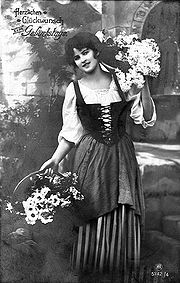
Altogether carte du jour from 1918, showing a young woman wearing a mod dirndl.
In Austria, the wearing of folk costume was promoted past Viktor von Geramb (1884–1958), professor of folk civilisation at the universities of Graz and Vienna. He saw folk costume equally a ways of rejuvenating Austrian identity after the collapse of the Austro-Hungarian monarchy during the First World War.[xi] Von Geramb was critical of the tracht associations for insisting rigidly on the historic designs, which were treated as a uniform of the clan. He argued that, for folk costume to be a living tradition, it needed to limited the individuality of the wearer; thus designs and materials needed to exist adapted to contemporary culture and technology.[49] Accordingly, he worked with commercial firms on finding material and designs that would permit the product of folk costume in large quantities. Consequently, Alpine tracht gained in full general popularity and even spread to eastern Austria, where it had non been role of the traditional clothing culture. The dirndl was increasingly perceived as the Austrian national dress.[11] [50]
In 1930, the Wallach brothers supplied the stage costumes for the operetta The White Horse Inn (Im weißen Rössl). The romantic comedy presented an idyllic motion picture of the Austrian Alps and had long runs in cities like Berlin, Vienna, Munich, London, Paris and New York. Inspired by the lively innkeeper heroine, the dirndl became an international fashion phenomenon, always with an apron and usually with deep décolletage.[4] [45] [47] [51] This widespread adoption was helped forth past a general 1930s trend to a silhouette which matched the folk costume: full skirts, higher hemlines, broader shoulders and tailored waists.[52] [31]
The dirndl was also promoted through the Trapp Family Singers, who wore dirndls during their performance at the Salzburg Festival (1936), and subsequently on their worldwide tours.[53] In improver, the picture Heidi, with Shirley Temple in the atomic number 82 role, became a hitting in 1937. By that twelvemonth, the dirndl was considered a 'must' in the wardrobe of every stylish American adult female.[52] [31]
Cribbing by the Nazis (1930s – 1945) [edit]

A young German girl in dirndl watching boys playing.
German traditional costume, including the dirndl, was instrumentalized by the Nazis as a symbol of pan-German language identity in the countries nether Nazi rule (Germany from 1933, Austria from 1938).[11] The dirndl was used to promote the Nazi ideal of the German adult female as difficult-working and fertile.[54] [31] An example is a propaganda photo released by the (Nazi Party) Office of Racial Politics (right), showing a immature blonde girl wearing a dirndl, watching over small boys playing.
Jews were forbidden to use "folk civilisation", even though they had played such a prominent function in documenting and promoting information technology.[55] [56] In 1938, the Wallach brothers were forced to sell their business under cost. Moritz Wallach emigrated to the United States, followed soon later past Julius. Their brother Max, who had also been involved in the business, was interned in Dachau concentration camp and was murdered at Auschwitz in 1944.[45] [46] [47] [57]
Viktor von Geramb, who had promoted the dirndl in Austria, lost his position at the University of Vienna in 1938 because of his public opposition to Nazi racial theory. He was specially criticized for his strong attachment to Christian ideas of homo worth. He was restored to his position at the academy only afterwards the defeat of the Nazi régime in 1945.[50] [58]
The National Socialist Women'southward League established the office of the "Reich Commissioner for High german costume" under the leadership of Gertrud Pesendorfer (1895–1982).[59] [60] [61] In 1938, she published dirndl designs past Gretel Karasek (1910–1992), which Pesendorfer described as "renewed costume".[62] Pesendorfer claimed that Karasek fabricated the following innovations from traditional designs: the neckband was removed, allowing display of décolletage; long sleeves were replaced by puff sleeves; the waist was emphasised with tighter lacing and buttons; and the skirt was reduced to mid length. The overall effect accentuated the female class and peculiarly the breasts.[threescore] [63] [59] Pesendorfer described the new mode every bit "de-catholicised" (entkatholisiert); she said her goal was to free the costume of "overburdening by church, industrialization and fashionable cries" and "foreign influences" and to let the "rogue sub-culture" dorsum again.[60] [61] [63] However, Pesendorfer´s claims are open to skepticism, since all the innovations allegedly made by Karasek were already present in the previous decades during which the dirndl evolved as a fashion.
Refuse and resurgence (1945 – present) [edit]

Seated women wearing dirndls from the 1970s.
The Second World State of war (1939–1945) began a downturn in the popularity of the dirndl. After Hitler'due south invasion of Poland in 1939, American and British consumers began rejecting all things German. In turn, new fashion influences appeared in popular culture, such every bit the picture Gone With the Wind, which premiered less than three months after the fall of Warsaw. By 1941, the dirndl had been replaced equally an American mode craze by the wasp waist.[31]

In Germany and Austria, the dirndl declined in popularity, especially in the cities.[31] [64] Its image had been tarred past association with the Nazis, like other Germanic traditions, such as beer-drinking and sausages.[65] Traditional clothing was often associated with bourgeois political views. As a result, the dress was regarded as old-fashioned or rustic by many, particularly those connected with the style manufacture.[64] [32] [11] [56]
Nevertheless, many others continued to wear the dirndl equally a wearing apparel for festive occasions, both in the countryside and in cities such as Munich. Dirndls were regarded as suitable vesture for attending church, public holidays, Oktoberfest and other festive occasions. The dirndl was peculiarly popular in Bavaria equally a bridal dress.[66]
A wider revival of interest came with the 1972 Summer Olympics in Munich. Led by Silvia Sommerlath (now Queen Silvia of Sweden), the hostesses wore sky-blueish dirndls as a promotion of Bavarian identity.[32] [67] [31] Civilisation historian Simone Egger comments, "As (Sommerlath) in 1972 made headlines as an Olympia hostess in a dirndl, then every woman wanted to have a dirndl."[68] [38]
In the 1980s, there was a further revival of involvement in the dirndl, as traditional clothing was adopted past the environmental and anti-nuclear movements.[38] The rural connotations of the clothing and the fact that it is produced from natural, rather than synthetic materials, become well with a desire to return to a "world that is intact".[32] [11] [56]
Get-go in the late 1990s, dirndls and lederhosen experienced a boom in Republic of austria and Bavaria, with some commentators speaking of a "dirndl Renaissance".[31] [56] [64] [32] [69] Past 2013, information technology had become standard for every immature Bavarian to take traditional wearable in their wardrobe.[32] [69] This increased involvement in traditional clothing was noticed by style houses. Since the 2000s, increasing numbers of fashion houses take become involved in designing and selling high-end versions.[64] [32] [70] The garment was praised in 2001 past designer Vivienne Westwood during a visit to a manner issue in Republic of austria. When some of the attendees criticized the garment as old-fashioned, she responded, "I do not understand you lot Austrians. If every woman wore a dirndl, there would not be any more ugliness". Subsequently, Westwood and her married man were honoured with the tile "Ambassador for Tracht" in 2010.[11] [56] [71]

Beer waitress wearing a dirndl at Oktoberfest.
Dirndls and lederhosen take long been standard attire for staff at Volksfeste, but in the 1970s visitors at the festivals did not normally wear folk costume, even at Oktoberfest. Simone Egger comments that the idea of wearing folk costume to Oktoberfest would previously take been considered "completely absurd, even embarrassing." Now the idea of wearing jeans to a Volksfest is unthinkable: folk costume is considered obligatory.[38] In a study in 2004, Egger institute that, from a sample group of those attending Oktoberfest, fifty% were wearing tracht for the first time. She found that the enthusiasm for tracht clothing was increasing every year.[72]
One reason given for the increasing popularity of the dirndl and lederhosen is an increased conviction in German self-identity. In the years following the Second Earth War, at that place was oft a shame in German identity considering of the crimes of the Nazi régime. In recent decades, at that place has been a celebration of being High german.[11] [64] [32] [31] This "new patriotism" was evident in the support for the German football team at the 2006 FIFA World Cup.[73] Co-ordinate to announcer Michaela Strassmair, "Equally the international media arrived in Munich for the World Cup, they all wanted to see the same picture and share information technology with the world: pretty girls in Munich wearing dirndls."[38]

Visitors to Oktoberfest wearing dirndls, 2012.
The culture historian Peter Peter comments on this increased pride in High german identity and traditions:[74]
At present there is a new generation that did not know the problems of the Cold War or the Second World State of war, for whom it is absurd to endeavour these old-fashioned things. Information technology´s advanced in a sure style to rediscover that even sauerkraut tin can be an excellent dish. I think a very good symbol of this new Germany is the Oktoberfest. Twenty years ago nobody in that location would dress in the traditional Bavarian costume. At present everybody does it and it doesn´t seem either nationalistic or jingoistic. The Oktoberfest, with its enormous number of beer consumers, is a wonderful example of the new Germany that combines iconic tradition with open up-mindedness. Information technology brings people and peoples together more fifty-fifty than football. It is non nationalist – it is now a symbol of German hospitality.
Other commentators link the upsurge in folk costume to economic insecurity acquired past globalization, prompting a return to traditional cultural symbols.[69] Simone Egger concludes that the renewed popularity of traditional article of clothing is driven by desires for community and belonging, symbolized by folk costume. These desires stand up in tension with the desire for individuality, expressed in alterations and ornament.[75] Culture journalist Alfons Kaiser makes similar observations:[76]
Simply as jeans, originally rural clothing, were used as an urban antitoxin to tradition, then dirndl and lederhosen show that, a generation later, people in their metaphysical homelessness are nevertheless in a circuitous way missing the traditional rural values. When 1 puts an detail with traditional pregnant on one´southward body, naturally one transfigures and romanticizes life on the land, really so difficult and frequently roughshod. All this is typical of our time. From yoghurt to magazines with rural themes, ane abandons oneself to the illusion of the good erstwhile times, in which the windowpanes can notwithstanding keep out the common cold wind of globalization."
The dirndl is increasingly alluring attending apart from its area of origin. In 2019, the Times of India ran an article featuring Bollywood actress Celina Jaitley wearing a dirndl; she urged other Indian women to add the dress to their wardrobe.[77]
Recent customs by country [edit]
Republic of austria [edit]
In Republic of austria, dirndls continue to be worn on public occasions, even by younger women. The dirndl is considered an important office of Alpine folk culture. Other aspects of folk culture are Lederhosen for men, traditional sports (eastward.g. shooting, music, crossbow), skills (eastward.yard. embroidery) and musical traditions (e.g. singing Christmas carols and Schuhplattler dance groups).[78] The folk civilisation is promoted by and protected by local folk culture associations, which are affiliated with the Bund der Österreichischen Trachten- und Heimatverbände (Federation of Austrian folk costume and homeland associations).[79]
The Catholic church building has played an important role in promoting the dirndl in Austria; traditional dress is worn for worship services, peculiarly the major church holidays (eastward.yard. Easter, Pentecost, Corpus Christi) and saints´ banquet days. The Tyrol has a tradition of the heiligen Tracht (holy folk costume), which is not to exist worn on secular occasions marked by drinking.[eleven]

Traditional costume of the Volks- and Schuhplattlergruppe from Faakersee in Carinthia, Austria.
Folk costume also continues to be worn for almost weddings and festivals. Former traditions are carefully maintained among inhabitants of Tall areas, even though this is seldom obvious to the visitor: many people are members of cultural associations where the Tall folk culture is cultivated. At cultural events, the traditional dirndl is the expected dress for women. Visitors can get a glimpse of the rich customs of the Alps at public Volksfeste. Even when large events characteristic simply a fiddling folk culture, all participants take part with gusto. Skilful opportunities to see local people jubilant the traditional civilisation occur at the many fairs, wine festivals and firefighting festivals which fill weekends in the Austrian countryside from spring to fall. But in the region surrounding Vienna is the traditional folk culture non a regular office of daily life.[78]
Some regions are especially known for their stiff dirndl traditions, such as the Tyrol, the Salzkammergut and the Wachau region of Lower Republic of austria.[23] [11]
In Austria, the dirndl is a symbol of national identity, seen in Austria equally a national symbol.[80] In tourist settings, staff in offices, restaurants, wineries and shops often wear dirndls every bit a work uniform; this is also the case in the non-Alpine regions in the east of Austria.[11] Fifty-fifty in everyday life, many Austrian women wear dirndls as an culling to other fashions.[xi] [18]
Festivals at which dirndls are expected dress include festivities for raising the Maypole on one May, the Narzissenfest (daffodil festival) during May in Bad Aussee,[81] the Salzburg Festival and the Ausseer Kirtag in September.[18] Styles are both less improvident and testify less décolletage than at Oktoberfest.[eleven]
In Austria, and other parts of south cardinal Europe, there are literally splashy events known as Dirndlspringen, in which attractive young women, are judged past how well they jump, or even merely step, from a diving lath into a lake or a swimming pool while wearing the dirndl, using it every bit a swimdress.[18]
Germany [edit]

Adult female wearing dirndl in the style of Isarwinkler Tracht, near Bad Tölz (Bavaria).

Women in festival dirndls (Wiesntrachten) at Oktoberfest.
In Germany, the dirndl is traditionally worn just in Bavaria,[82] where it is deeply integrated in the traditional culture.[11] For instance, dirndls are traditionally worn by women attention formal ceremonies of the Catholic church. In many Bavarian villages, processions to laurels St George and St Leonard are special occasions for wearing Tall tracht.[83] The traditional dirndl is also the normal attire of women attention events associated with Alpine folk culture.[11] Volksfeste frequently characteristic events at which traditional dirndls from regions are worn, as illustrated in the photograph on the right. In all of these activities, the dirndls normally worn are the traditional local designs, considered most suitable for formal occasions. Modern commercially designed dirndls are worn on less formal occasions.[84]
The traditional designs are promoted past and protected by local folk culture associations affiliated with the Bayerische Trachtenverband (Bavarian folk costume association). The designs specify the traditional materials, patterns and colours of clothing, together with jewellery, hats, etc. Currently, six official types of Tall tracht are recognized in Bavaria, each with designs for men (lederhosen) and women (dirndl): Miesbacher Tracht, Werdenfelser Tracht, Inntaler Tracht, Chiemgauer Tracht, Berchtesgadener Tracht and Isarwinkler Tracht.[85] [86] [87]
The dirndl is regarded as a symbol of Bavaria. It is oftentimes worn past women working in businesses related to tourism or traditional culture, including Volksmusik, restaurants and beer gardens.[twenty]
In recent decades, women from other parts of Germany have shown increasing interest in the dirndl as a festival dress. This is especially axiomatic in changing fashions at Oktoberfest, the world´s largest Volksfest. Until the 1970s, most visitors to Oktoberfest did non clothing traditional tracht; it was mutual to wear jeans. Since the late 1990s dirndls and Lederhosen accept come to be regarded as obligatory wear at the festival.[88] [31] [74] [32] [38] [26] The proper noun Wiesntracht is given to dirndls and other tracht vesture worn for Oktoberfest (Wiesn refers to the Theresienwiese, where the Oktoberfest events occur).[33] Oktoberfest dirndls tend to be more colourful and revealing. Skirts are often higher up the knee, and deep décolletage is very frequent.[11] [26] In 2005, gossip magazine Bunte reported that at Munich Airport in that location was a identify which was always of import for fashion observers at Oktoberfest time: the women´s toilets in Domestic Arrivals. "In that location the ladies who accept flown in wearing street clothes with shouldered clothes-bags vanish - and appear from Baggage Collection in total dirndl bloom. Because they don´t trust themselves to board the aircraft as Bavarians, simply arriving in Munich not dressed for the Wiesn would exist unseemly."[89]
There is increasing evidence that Germans are coming to view the dirndl as a High german, rather than an exclusively Bavarian symbol. In the by few years, "Oktoberfest" celebrations take developed in parts of Frg remote from Bavaria, such equally Münster in Westphalia. Dirndls and lederhosen are at present considered an intrinsic part of such events.[90] Other bear witness is the successful marketing of dirndls in the High german national colours for wearing at football matches, noticeable at the 2006 FIFA Earth Loving cup.[38] Meanwhile, high-stop German manner houses are designing and selling their ain designs.[31] [70]
Italy [edit]

Young adult female wearing traditional dirndl during sacramental procession, Seis am Schlern, Southward Tyrol, 2014.
In Italy the dirndl is part of the traditional clothing civilization in the Alpine province of South Tyrol (German: Südtirol; Italian: Alto Adige). The region was office of the Austrian county of Tyrol before the Outset World War, but was ceded to Italy in 1919 in the Treaty of St-Germain at the terminate of the war. In Due south Tyrol, both German and Italian are official languages, and Tyrolean traditions including the dirndl remain securely integrated in the civilization.[91] The dress is worn on festive occasions, such as processions of the Cosmic church building. Traditional designs vary between regions, valleys and sometimes villages.[92]
The local dirndls and lederhosen are displayed in several local museums. There are permanent exhibitions at the Due south Tyrolean Folklore Museum in Teodone, the Collepietra Local Museum and the Bolzano Municipal Museum. Public events featuring folk costume include the Val Gardena sociology festival ("Gröden in Tracht") and the Country Wedding in Castelrotto.[92]
Principality of liechtenstein [edit]
Folk costumes for women in Liechtenstein correspond to the definition of a "dirndl" in English, although the local tracht association (Liechtensteinische Trachtenvereinigung) discourages the name "dirndl". The official national wearing apparel of Liechtenstein features a blackness brim and a white blouse with crocheted and bobbin laced necklines and sleeves. Bodices and aprons are made of silk; their traditional color was red, only modernistic designs frequently substitute blue or green. Equally worn for national apparel, the bodice is decorated with silvery embroidery featuring a princely crown in the center of the bodice. Accessories include a black bike-shaped bonnet featuring silver embroidery, white lace gloves, white stockings and black shoes with a silver buckle. Other variations include floral headbands (Schappile) or crown-shaped headpieces (Krönle).[ citation needed ]
The current designs have been in use since at to the lowest degree the 1930s, but their origins can be traced much earlier. Similar designs have been found in archaeological remains from Vaduz, Gamprin and Eschen. Especially notable is an excavated church graveyard in Mauren from around 1700, which included well-preserved garments and a bonnet.[93]
Switzerland [edit]
In Switzerland, the dirndl is the official outfit for certain representations, events, cultural shows and singing sometime folk songs often involving yodelling.[94]
In the German diaspora [edit]
Outside its countries of origin, the dirndl has become an ethnic costume, worn as an identity marker by members of the German diaspora. This term refers to High german-speakers and their descendants who live in countries where German language is a minority language.
Germans, Austrian, Swiss and Scandinavian people migrated to N America in the 19th century. Germans made a strong contribution to the gene pool of Montana, Minnesota, the Dakotas, Missouri, Wisconsin, New York City[95] and Chicago. The German American ethnic group (German language: Deutschamerikaner) are their descendants in North America, and form function of the worldwide German language diaspora.[96] [17]
Beginning in 1920 and especially afterwards Earth War II, many Danube Swabians migrated to the United States, Brazil, Canada, Mexico, Austria, Australia, and Argentine republic.[97] Across the United states there are dozens of German-American cultural or heritage clubs, such every bit the Donauschwaben heritage clubs.[95] In these clubs, members host events and festivals to preserve and/or celebrate their heritage with the surrounding communities; examples include parades for Von Steuben 24-hour interval. During these festivals, participants often clothes in traditional outfits such as dirndls and lederhosen.
Dirndls and lederhosen are also worn as party wearable at Oktoberfest celebrations effectually the world. This is especially the case when the celebration takes place in a German diaspora customs, such as the Oktoberfest celebrations at Colonia Tovar in Venezuela or the Fiesta Nacional de la Cerveza in Villa General Belgrano, Argentina.
Dirndls in pop civilization [edit]
Musical mentions of dirndls [edit]
The dirndl is mentioned in the song "Plow Effectually", composed in 1959 by Harry Belafonte, Alan Greene and Malvina Reynolds. "Dirndls and petticoats, where have you gone?" This song was originally recorded by the Kingston Trio.
Films featuring women in dirndl costumes [edit]
- Above Suspicion (1943)
- Almost Angels
- Charlie'southward Angels
- Chitty Chitty Bang Bang
- Ferris Bueller's Day Off
- Heidi (1937) and (1968)
- Heidi's Song
- The Legend of Silent Night
- Lissi und der wilde Kaiser
- The Merry Wives of Tyrol
- Miss Congeniality
- The Monastery's Hunter (1935)
- National Lampoon'due south European Vacation
- The Pink Panther (1963)
- The Pink Panther Strikes Again
- The Producers
- Salzburg Stories (1957)
- Sissi
- Snow White and the 7 Dwarfs
- The Sound of Music
- Summer in Tyrol
- The Trapp Family
- The Trapp Family in America
- The Violin Maker of Mittenwald
- Where Eagles Dare
- The White Horse Inn (1926), (1948), (1952) and (1960)
The dirndl in philately [edit]
The Austrian postal service regularly issues postage stamps featuring dirndls and other Austrian folk costumes. The postage series is released under the championship Klassische Trachten (classic folk costumes). In April 2020, the 85 cent stamp featured the bluish printed dirndl worn as everyday workwear in the Wachauer Tracht tradition.[15] In 2016, the postal function issued a novelty postage featuring an embroidered dirndl; merely 140,000 specimens were issued.[98]
Run across too [edit]
 | Wikimedia Commons has media related to Dirndl. |
- Austrian folk dancing
- Lederhosen
- Schuhplattler
- Tracht
- Folk costume
- Volksfest
- Oktoberfest
References [edit]
- ^ a b c d e f g Gexi Tostmann, The dirndl: With instructions. Panorama, Vienna, 1990.
- ^ a b c Concise Oxford English Dictionary, twelfth edition, ed. Angus Stevenson and Maurice Waite. Oxford Academy Press, Oxford, 2011, page 406.
- ^ "Dirndlkleid, das". Duden . Retrieved 31 July 2020.
- ^ a b c d e f g h i j "Ein Kleid für die Dirn' – Style & Kosmetik – derStandard.at › Lifestyle". Derstandard.at. 5 September 2006. Retrieved 7 May 2020.
- ^ Ethnic Clothes in the United States: A Cultural Encyclopedia, eds. Annette Lynch; Mitchell D. Strauss (Lanham, Physician: Rowman & Littlefield, 2015), p. 100.
- ^ "Dirne, die". Duden . Retrieved 30 April 2020.
- ^ "Dirndl, das". Duden . Retrieved xxx Apr 2020.
- ^ a b "Diandl Dirndl, das". Bayrisches Woerterbuch . Retrieved 27 July 2020.
- ^ Weissengruber 2004, p. 15, 18f.
- ^ Egger 2008, p. xvi.
- ^ a b c d e f chiliad h i j k l m n o p q r s t Cordula Reyer (19 September 2010). ""Was kann das Dirndl dafür, dass es missbraucht wurde?" [Interview with Gexi Tostmann]". Welt (in German). Retrieved iv May 2020.
- ^ a b c d e f g Gexi Tostmann, Das Dirndl: Alpenländische Tradition und Mode. Christian Brandstätter, Vienna, 1998, Pp. 32f.
- ^ "Was ist der Unterschied zwischen Dirndl und Tracht?". /www.gutefrage.cyberspace . Retrieved 30 Nov 2020.
- ^ "Wachauer Tracht". www.wachaublog.at . Retrieved 16 December 2020.
- ^ a b c "Sondermarken-Highlight Apr 2020". www.post.at . Retrieved 19 October 2020.
- ^ a b F, José Blanco; Hunt-Hurst, Patricia Kay; Lee, Heather Vaughan; Doering, Mary (23 November 2015). Clothing and Style: American Style from Caput to Toe [4 volumes]: American Fashion from Caput to Toe. ABC-CLIO. ISBN9781610693103 – via Google Books.
- ^ a b c d e f g h i "The essential Dirndl (and Lederhosen) guide". www.austria.info . Retrieved nine June 2020.
- ^ Egger 2008, p. 53f..
- ^ a b c d e f thousand "German language Dirndl – an illustrated guide". Destination-munich.com . Retrieved eighteen June 2020.
- ^ a b c d e Daniela Müller and Susanne Trettenbrein. Alles Dirndl. Anton Pustet Verlag, Salzburg 2013. ISBN 978-3-7025-0693-3
- ^ "Dirndlbluse, die". Duden . Retrieved thirty July 2020.
- ^ a b Franz C. Lipp, Elisabeth Längle, Gexi Tostmann, Franz Hubmann (eds.): Tracht in Österreich. Geschichte und Gegenwart. Brandstätter, Vienna, 1984, ISBN 3-85447-028-2.
- ^ a b c Paul Wolff, Alfred Tritschler and Harald Busch: Deutschland Süden Westen Norden: Ein Bildband von deutscher Landschaft, ihren Städten, Dörfern und Menschen. In German, with English language translation by Eberhard Beckmann. Umschau, Frankfurt am Main 1950. Pp. 9–11.
- ^ Christine Zwygart (2014). "Wie zieht human eine Tracht an?" (PDF). Landliebe . Retrieved 22 October 2020.
- ^ a b c d e f "Fesch und zünftig auf die Wiesn!". Bild (in German language). 17 September 2015. Retrieved 14 May 2020.
- ^ "Bavarian jewelry". store.oktoberfest.de . Retrieved four September 2020.
- ^ a b "The Dirndl: The long history of a very special traditional costume". www.oktoberfest.de . Retrieved 4 September 2020.
- ^ Ulrike Kretschmer, Frank Duffek and Bettina Schippel, Bayerischen Alpen: Traum in weiss-blau, Reader´s Assimilate, Stuttgart, 2013, pp. 54, 56. ISBN 978-three-89915-946-2
- ^ "Vom Schleier und Kopftuch zur Linzer Goldhaube". Salzburg Museum (in German). Retrieved 16 August 2020.
- ^ a b c d e f one thousand h i j thou l m Horn, Heather (20 September 2015). "The Devil Wears a Dirndl". The Atlantic . Retrieved 13 May 2020.
- ^ a b c d e f g h i Eddy, Melissa (28 September 2013). "Dirndl, Dress of Past, Makes a Comeback in Bavaria". The New York Times . Retrieved 9 May 2020.
- ^ a b Egger 2008, p. 15.
- ^ a b Bruno Köhler: Allgemeine Trachtenkunde in sechs Teilen. Reclam, Leipzig, 1900
- ^ Elisabeth Mikosch, "The Manufacture And Merchandise Of Luxury Textiles In The Age Of Mercantilism" (1990). Textile Society of America Symposium Proceedings 612, pages 58f. "The Manufacture And Merchandise Of Luxury Textiles In The Age Of Mercantilism Mercantilism". Retrieved 8 October 2020.
- ^ a b Fernand Braudel: Civilisation and Capitalism, 15th–18th Centuries, Vol 1: The Structures of Everyday Life, William Collins & Sons, London, 1981, pp. 313–315.
- ^ James Laver: The Concise History of Costume and Fashion, Abrams, 1979, p. 62
- ^ a b c d e f g Strassmair, Michaela (September 2019). "Typisch Oktoberfest? Darum gehört ein Dirndl eigentlich nicht auf die Wiesn". www.focus.de (in German). Retrieved ix May 2020.
- ^ Gabriele Crepaldi: Das 19. Jahrhundert. Translated from Italian into High german past Irmengard Gabler and Dr Karl Pichler. P. Parthas, Berlin, 2005, p. 14. (Quotation translated into English language by contributor.)
- ^ Neil MacGregor, Germany: Memories of a nation, Penguin, London, 2016, pp. 112–130. ISBN 978-0-141-97978-6
- ^ a b c Lipp, Franz C., Elisabeth Längle, Gexi Tostmann, Franz Hubmann (eds.): Tracht in Österreich. Geschichte und Gegenwart. Brandstätter, Vienna, 1984, ISBN 3-85447-028-2.
- ^ Joseph Theodoor Leerssen, Anne Hilde van Baal, and Jan Stone, eds. Encyclopedia of romantic nationalism in Europe (Amsterdam University Printing, 2018.)
- ^ a b c Vereinigte Bayerische Trachtenverbände (ed.): Bayrisch Country, bayrisch Gwand, geschichtlicher Beitrag zur Trachten- und Heimatpflege in Bayern, anläßlich des 50. Gründungstages der Vereinigten Bayerischen Trachtenverbände. Chiemgauer Verlagshaus – Eigenverlag Vereinigte Bayerische Trachtenverbände, Traunstein 1976, OCLC 140201858.
- ^ "Geni site: Moritz Wallach". Retrieved eight June 2020.
- ^ a b c d e Monika Ständecke: Dirndl, Truhen, Edelweiss: die Volkskunst der Brüder Wallach. (in German) / Dirndls, Trunks, and Edelweiss. The Folk Art of the Wallach Brothers (in English). Jüdischen Museum, Munich, 2007. ISBN 978-3-9388-3220-2
- ^ a b c d Monika Ständecke: "Das Volkskunsthaus Wallach in München: Ein Beitrag über die 'Wiederbelebung' der 'Volkskunst' zur Zeit der Weimarer Republik." In: Jahrbuch für Europäische Ethnologie – Neue Folge. Brill, Leiden, 2008. Pp. 65–xc.
- ^ a b c d e Heidi Hagen-Pekdemir (thirty September 2015). "Bielefelder machten das Dirndl erst schick". Neue Westfälische (in German language). Retrieved 18 Apr 2020.
- ^ Egger 2008, p. 40f, 55.
- ^ Viktor von Geramb and Konrad Mautner: Steirisches Trachtenbuch, vol. 2. Leuschner & Lubensky, Graz 1935, p. 572
- ^ a b Michael J. Greger and Johann Verhovsek: Viktor Geramb 1884–1958. Leben und Werk. Verlag des Vereins für Volkskunde, Vienna 2007, ISBN 978-3-900358-27-iii
- ^ Ingrid Loschek: Reclams Mode- und Kostümlexikon, p. 168. sixth edition. Stuttgart, 2007.
- ^ a b Christianne Weber and Renate Moller. Manner und Modeschmuck 1920–1970 / Mode and Jewelry 1920–1970. Arnoldsche Verlagsanstalt, 1999.
- ^ Erfolgreiche Sympathiewerber: Prominente im Trachtengwand, in: Franz Hubmann: Tracht in Österreich – Geschichte und Gegenwart, pp. 220–225.
- ^ Irene Guenther: Nazi chichi?: Fashioning women in the Third Reich. Berg, Oxford, 2010. ISBN 978-ane-8597-3400-1
- ^ Elsbeth Wallnöfer (24 January 2014). "Von Dirndln, Trachten und Akademikerbällen – Kommentare der anderen – derStandard.at › Meinung". Derstandard.at . Retrieved 4 April 2017.
- ^ a b c d east Bethany Bell (22 Oct 2012). "Lederhosen and dirndl dresses make a comeback". BBC News Magazine . Retrieved 25 Baronial 2020.
- ^ "Geni site: Max Wallach". Retrieved thirty July 2020.
- ^ James R. Dow and Olaf Bockkorn: The Written report of European ethnology in Austria. Asghate, Aldershot (England), 2004, ISBN 0-7546-1747-5 pp. 110ff.
- ^ a b "Projekt – Universität Innsbruck". Uibk.ac.at . Retrieved four Apr 2017.
- ^ a b c Elsbeth Wallnöfer: Geraubte Tradition. Wie dice Nazis unsere Kultur verfälschten. Sankt Ulrich, Augsburg, 2011. ISBN 3867441944
- ^ a b Gurschler, Susanne (24 October 2013). "NS-gerecht geschnürt, HauptNews Detail". Echoonline.at . Retrieved iv Apr 2017.
- ^ Gertrud Pesendorfer. Neue deutsche Bauerntrachten. Tirol. Callwey, Munich, 1938.
- ^ a b Reinhard Jellen. "Nazierfindung Wiesndirndl. Interview mit der Volkskundlerin Elsbeth Wallnöfer über die Modernisierung des Brauchtums durch die Nationalsozialisten. Telepolis, 27. September 2012". www.heise.de . Retrieved 30 April 2020.
- ^ a b c d eastward "Keine Angst vorm Dirndl – Mode & Kosmetik – derStandard.at › Lifestyle" (in German). 12 August 2008. Retrieved 24 May 2020.
- ^ Neil MacGregor, Germany: Memories of a nation, pp. 188f.
- ^ Dee C. Pattee. Munich in your pocket, fourth edition, 1989, page 69.
- ^ Gerlach, Franziska (4 September 2015). "Dice Macht der Tracht". Süddeutsche Zeitung (in High german). Retrieved 13 Baronial 2020.
- ^ Egger 2008, p. 42-44.
- ^ a b c Meret Baumann (10 January 2014). "Dice neue Animalism am Dirndl". Neue Zürcher Zeitung (in German). Retrieved 19 Baronial 2020.
- ^ a b DW (English) (x September 2010). "The Dirndl Folk Apparel – euromaxx". Archived from the original on 13 December 2021 – via YouTube.
- ^ "Vivienne Westwood ist Botschafterin der Tracht 2010". Vol.at (in German). v March 2010. Retrieved 20 December 2020.
- ^ Egger 2008, p. 46.
- ^ Arnd Krüger: Sport and Identity in Frg since Reunification. In Philip Dine & Seán Crosson (eds.): Sport, representation and evolving identities in Europe. P. Lang, Bern, 2010, pages 289–316.
- ^ a b Neil MacGregor, Frg: Memories of a nation, p. 189.
- ^ Egger 2008, p. 109f.
- ^ Alfons Kaiser (five October 2013). "Dirndlfieber: Mit aller Tracht (English language translation by correspondent)". Frankfurter Allgemeine Zeitung (in German language). Retrieved 19 August 2020.
- ^ "Celine Jaitley decks up in German traditional dress 'Dirndls' for New year's day celebrations". Times of Republic of india. 31 December 2019. Retrieved i September 2020.
- ^ a b Anita Ericson, Österreich [Marco Polo travel guide], 13th edition, Marco Polo, Ostfildern (Germany), 2017, Pp. 21f.
- ^ "Bund der Österreichischen Trachten- und Heimatverbände". www.trachten.or.at . Retrieved xxx May 2020.
- ^ Anita Ericson, Österreich, Pp. 9, 31.
- ^ "Narzissenfest". www.narzissenfest.at . Retrieved 9 June 2020.
- ^ "Dirndl Schleife – ein elegantes Modeaccessoire aus Bayern" (in German). Retrieved 26 January 2022.
- ^ Kretschmer et al., Bayerischen Alpen: Traum in weiss-blau, pp. 10f, 54–57.
- ^ "Ratgeber rund um das Dirndl und die Tracht" (in German language). alpenclassics.de. Retrieved 31 March 2022.
- ^ Uli Landsherr: Trachtler schee boarisch. Husumer Verlagsgesellschaft, Husum 2008, ISBN 978-iii-89876-413-ane.
- ^ Paul Ernst Rattelmüller: Bayerische Trachten. Verlag Riedler, Rosenheim 1955.
- ^ Vereinigte Bayerische Trachtenverbände (ed.): Bayrisch Land, bayrisch Gwand, geschichtlicher Beitrag zur Trachten- und Heimatpflege in Bayern, anläßlich des l. Gründungstages der Vereinigten Bayerischen Trachtenverbände. Chiemgauer Verlagshaus – Eigenverlag Vereinigte Bayerische Trachtenverbände, Traunstein 1976, OCLC 140201858
- ^ Egger 2008, p. 11-xv.
- ^ Bunte no. 38, Monday 15 September 2005, p. 79. Cited past Egger 2008, p. 45.
- ^ "Was human being über Münsters Oktoberfest 2018 wissen muss". Westfälische Nachrichten (in High german). 10 September 2018. Retrieved nineteen June 2020.
- ^ Uta Radakovich, Trachten in Südtirol, Reverdito, 2009, ISBN 978-8863140361.
- ^ a b "Traditional Costumes in South Tyrol". www.suedtirolerland.information technology . Retrieved 21 December 2020.
- ^ "Unsere Geschichte". Liechtensteinische Trachtenvereinigung . Retrieved five December 2021.
- ^ "What are the Swiss traditional clothes?".
- ^ a b e.Five., Deutsche Zentrale für Tourismus. "German Clubs beyond America".
- ^ Aspera. "memoria.ro – bibliotecă digitală de istorie recentă".
- ^ "bibliotecă digitală de istorie recentă". Memoria.ro . Retrieved 4 April 2017.
- ^ "Österreichische Post: Das Dirndl als Briefmarke". dirndlschuerze.de . Retrieved 19 Oct 2020.
Bibliography [edit]
- Egger, Simone (2008). Phänomen Wiesntracht. Identitätspraxen einer urbanen Gesellschaft. Dirndl und Lederhosen, München und das Oktoberfest. Munich: Herbert Utz. ISBN978-3-8316-0831-7.
- Greger, Michael J. and Johann Verhovsek: Viktor Geramb 1884–1958. Leben und Werk. Verlag des Vereins für Volkskunde, Vienna 2007, ISBN 978-three-900358-27-iii. (in German)
- Guenther, Irene: Nazi chic?: Fashioning women in the Third Reich. Berg, Oxford 2010. ISBN 978-i-8597-3400-1 (in English language)
- Hollmer, Heide and Kathrin Hollmer: Dirndl. Trends, Traditionen, Philosophie, Popular, Stil, Styling. Edition Ebersbach, Berlin 2011. ISBN 978-3-86915-043-7 (in High german)
- Lipp, Franz C., Elisabeth Längle, Gexi Tostmann, Franz Hubmann (eds.): Tracht in Österreich. Geschichte und Gegenwart. Brandstätter, Vienna, 1984, ISBN 3-85447-028-ii. (in German)
- Müller, Daniela and Susanne Trettenbrein: Alles Dirndl. Anton Pustet Verlag, Salzburg 2013. ISBN 978-3-7025-0693-3. (in German)
- Pesendorfer, Gertrud: Neue deutsche Bauerntrachten. Tirol. Callwey, Munich, 1938. (in German language)
- Radakovich, Uta: Trachten in Südtirol, Reverdito, 2009, ISBN 978-8863140361. (in High german)
- Reuter, Ulrich: Kleidung zwischen Tracht + Mode. Aus der Geschichte des Museums 1889–1989. Museum für Volkskunde, Berlin, 1989. (in High german)
- Ständecke, Monika: Dirndl, Truhen, Edelweiss: die Volkskunst der Brüder Wallach / Dirndls, Trunks, and Edelweiss. The Folk Fine art of the Wallach Brothers. Jüdisches Museum, Munich 2007. ISBN 978-3-9388-3220-2 (in German language, with English translation)
- Ständecke, Monika: "Das Volkskunsthaus Wallach in München: Ein Beitrag über dice 'Wiederbelebung' der 'Volkskunst' zur Zeit der Weimarer Republik." In: Jahrbuch für Europäische Ethnologie – Neue Folge, ed. Ferdinand Schöningh. Brill, Leiden, 2008. Pp. 65–xc.
- Tostmann, Gexi: The dirndl: With instructions. Panorama, Vienna 1990. ISBN 978-3-8505-7001-5 (in English)
- Tostmann, Gexi: Das Dirndl: Alpenländische Tradition und Way. Christian Brandstätter, Vienna, 1998. ISBN 978-iii-8544-7781-5 (in German)
- Wallnöfer, Elsbeth: Geraubte Tradition. Wie die Nazis unsere Kultur verfälschten. Sankt Ulrich-Verlag, Augsburg 2011, ISBN 978-three-8674-4194-0. (in German)
- Weber, Christianne and Renate Moller. Mode und Modeschmuck 1920–1970 / Manner and Jewelry 1920–1970. Arnoldsche Verlagsanstalt, 1999. ISBN 978-iii-9253-6923-0. (in German language, with English translation)
- Weissengruber, Thekla (2004). Zwischen Pflege und Kommerz: Studien zum Umgang mit Trachten in Österreich nach 1945. Münster: Lit-Verlag.
External links [edit]
 | Look upwardly Dirndl in Wiktionary, the complimentary dictionary. |
| | Wikimedia Commons has media related to Dirndl. |
- The essential Dirndl (and Lederhosen) guide – Austrian Tourist Office website
- German language dirndl – Destination Munich
- The long history of a very special traditional costume – Oktoberfest website
- Traditional Costumes in South Tyrol – suedtirolerland.it
Links to online suppliers:
- Daller Tracht (Germany)
- Dirndl.com (Deutschland)
- Dirndl Karin Kolb (Frg)
- Finest Trachten (Germany)
- Trachten Kroiher (Deutschland)
- Kerstins Landhausmode (Germany)
- Official Oktoberfest shop (Germany)
- Ernst Licht (USA)
- Mydirndl.com (USA)
gibsontiorstionat.blogspot.com
Source: https://en.wikipedia.org/wiki/Dirndl
0 Response to "How Did Thr Designer of This German Folk Dress Use the Principles of Art"
Post a Comment